

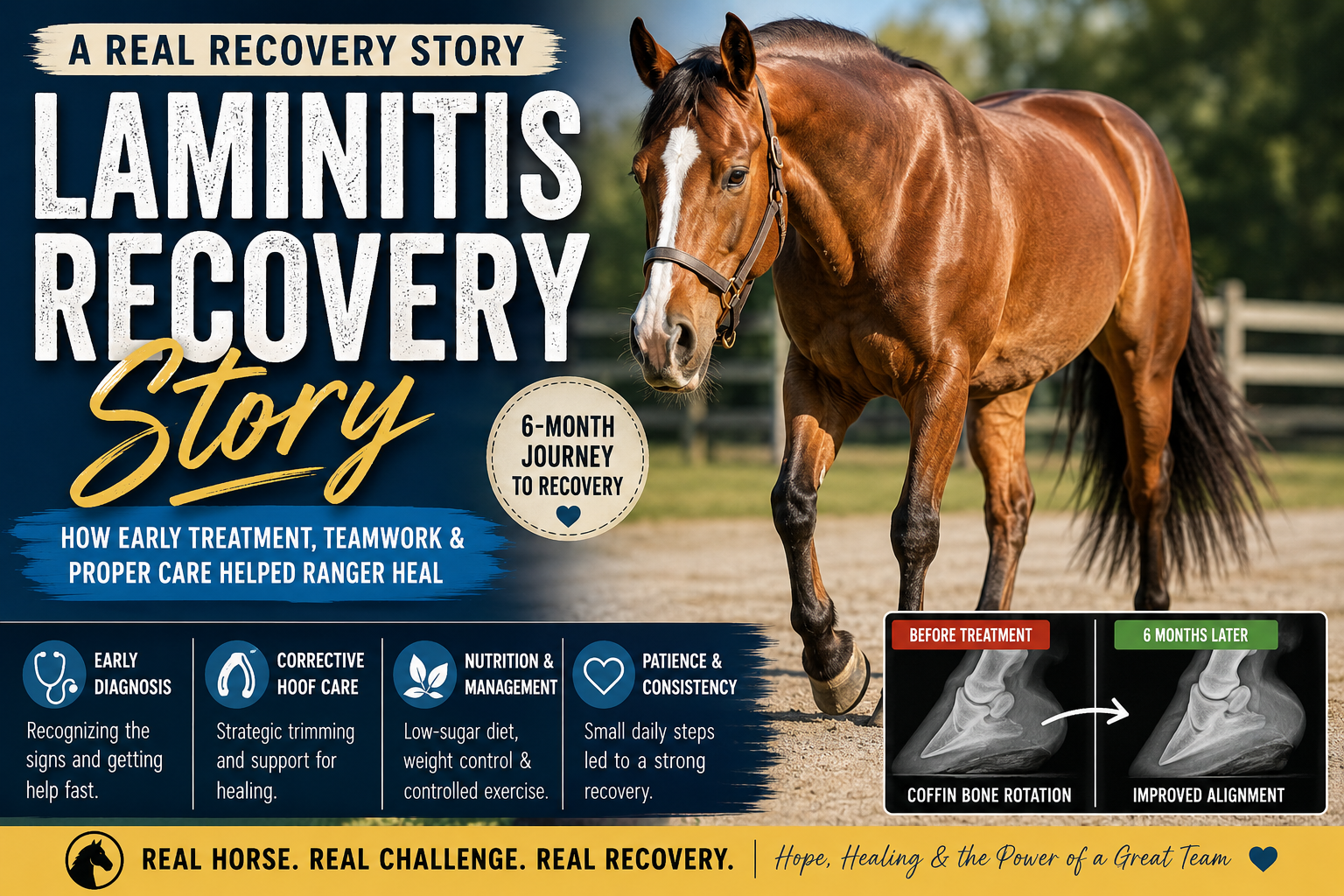
Laminitis Recovery Story: How Ranger Returned to Comfortable Walking After Early Treatment
| Horse Information | Details |
|---|---|
| Horse | Ranger |
| Breed | American Quarter Horse |
| Age | 12 Years |
| Sex | Gelding |
| Location | Lexington, Kentucky |
| Problem | Acute Laminitis |
| Main Causes | Rich spring pasture, excess body weight, high-sugar diet |
| Diagnosis | Clinical examination and radiographs |
| Treatment Team | Veterinarian + Certified Farrier + Owner |
| Recovery Time | Approximately 6 Months |
| Final Outcome | Returned to light riding with long-term management |
Meet Ranger
On a cool April morning near Lexington, Kentucky, Sarah Thompson walked toward her pasture expecting the same enthusiastic greeting she had received every morning for years.
Her Quarter Horse gelding, Ranger, normally trotted to the gate the moment he heard her truck.
This morning was different.
Instead of walking over, Ranger stood quietly beneath a maple tree.
His ears were forward.
He was alert.
But he barely moved.
Sarah assumed he had simply slept awkwardly or bruised a hoof while running the previous evening.
She wasn’t overly concerned.
Looking back later, she realized those first few minutes were the beginning of one of the biggest health challenges Ranger had ever faced.
The First Warning Signs
As Sarah approached, she noticed Ranger shifting his weight from one front foot to the other.
When he finally walked toward her, every step seemed careful.
He wasn’t obviously lame.
He wasn’t refusing to move.
Something simply looked…
…different.
Over the next several hours she noticed several subtle changes.
Early signs included:
- Walking slowly across gravel
- Turning with small, cautious steps
- Standing with both front feet stretched slightly forward
- Warm hooves
- Spending more time lying down
- Less interest in grazing
- Reduced energy
Individually, none of these signs seemed alarming.
Together, however, they formed a pattern that experienced veterinarians and farriers recognize as a potential warning sign of laminitis.
One of the most important lessons Sarah learned was that laminitis rarely starts with dramatic symptoms.
In many horses, the earliest signs are easy to overlook.
What the Owner Almost Did Wrong
Sarah later admitted there were several mistakes she nearly made.
Many horse owners have similar thoughts during the early stages of lameness.
She almost decided to:
- Wait several more days before calling the veterinarian.
- Turn Ranger back onto lush spring pasture.
- Continue feeding his regular grain ration.
- Assume it was only a stone bruise.
- Skip the farrier visit because Ranger had been trimmed only five weeks earlier.
Fortunately, a friend who owned several horses encouraged her to call the veterinarian immediately.
That single decision likely prevented far more serious hoof damage.
Waiting even a few extra days could have allowed inflammation inside the hoof capsule to worsen, increasing the risk of coffin bone rotation and a longer recovery.
How the Problem Was Identified
By early afternoon, Sarah had carefully observed Ranger several times.
She wrote down everything she noticed before calling the veterinary clinic.
Sarah noticed
- Reluctance to walk
- Shortened stride
- Warm front hooves
- Mild stiffness when turning
- Weight shifting between front feet
These observations provided valuable information before the veterinarian even arrived.
Keeping notes about changes in behavior, appetite, and movement can help your veterinarian build a clearer picture of what is happening.
The Veterinary Examination
Dr. Emily Carter arrived later that afternoon and began with a complete physical examination.
Ranger’s heart rate and respiratory rate were slightly elevated, which wasn’t surprising considering he was uncomfortable.
His body condition score was 7 out of 9.
Although Ranger looked healthy to Sarah, he had gradually gained weight over the winter.
That extra weight increased stress on already inflamed laminae.
The veterinarian carefully checked each hoof.
The front feet felt noticeably warmer than the hind feet.
When she palpated the digital arteries near the fetlock, the digital pulses were stronger than expected.
A bounding digital pulse is one of the classic findings associated with laminitis.
Next came hoof testers.
Ranger reacted consistently across both front feet, particularly around the toe region.
Although hoof tester responses alone cannot diagnose laminitis, they supported the clinical picture.
Dr. Carter explained that several different hoof problems can cause pain, including abscesses, bruises, fractures, and laminitis.
Radiographs would help confirm the diagnosis and guide treatment.
Radiograph Findings
Portable digital X-rays were taken that afternoon.
Sarah expected dramatic damage.
Instead, the veterinarian smiled reassuringly.
“The good news,” she explained, “is that we caught this early.”
The radiographs revealed approximately 3 degrees of coffin bone rotation in both front feet.
There was no evidence of sinking, and the sole depth remained acceptable.
Because structural damage was still relatively mild, Ranger had an excellent chance of returning to comfortable movement with prompt treatment and careful long-term management.
Dr. Carter also emphasized something Sarah had never considered before.
Radiographs are not only useful for confirming laminitis—they are an essential tool for planning corrective trimming.
Without imaging, the farrier would have far less information about the exact position of the coffin bone inside the hoof capsule.
The Farrier Assessment
The following morning, certified farrier Michael Reynolds reviewed Ranger’s radiographs before touching a hoof.
That decision reflected one of his guiding principles:
“Trim the bone, not just the hoof.”
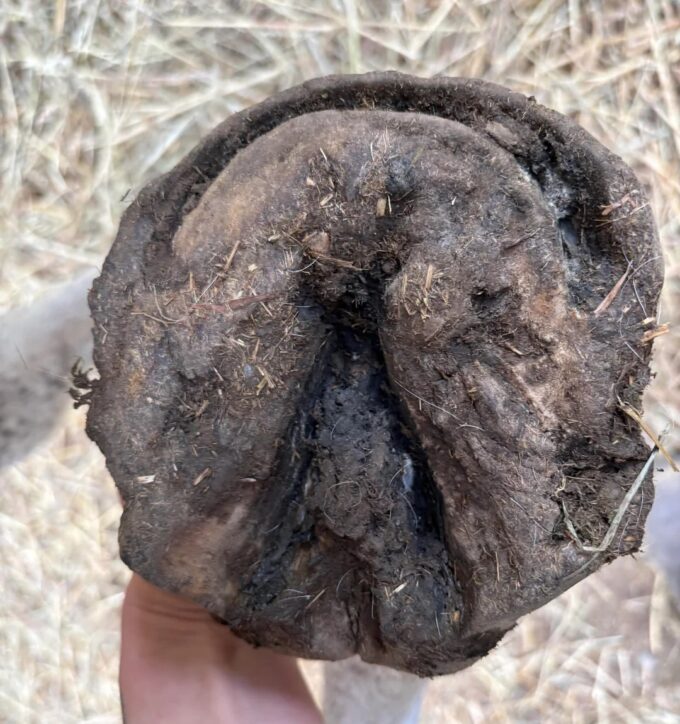
From the outside, Ranger’s feet didn’t appear severely overgrown.
However, careful measurements revealed several issues:
- Long toes increasing leverage on the weakened laminae.
- Underrun heels reducing support.
- Mild imbalance between the medial and lateral hoof walls.
- A delayed breakover point, forcing Ranger to exert more effort with every step.
Michael explained that during an acute laminitis episode, aggressive trimming can do more harm than good.
Instead of removing large amounts of hoof wall, he made only conservative adjustments designed to reduce mechanical stress while preserving as much stability as possible.
The goal wasn’t to create a perfect-looking hoof overnight. It was to make each step less painful and give the damaged laminae the best chance to heal.
To further improve comfort, supportive pads were fitted to help distribute weight more evenly across the hoof and reduce pressure on the painful toe region.
Before leaving, Michael outlined the long-term plan. Ranger would be reassessed every four to five weeks, with each trim guided by his comfort, hoof growth, and follow-up radiographs.
Finding the Real Cause
The next step wasn’t trimming Ranger’s hooves again or changing his medication.
It was answering one important question:
Why did this happen?
Treating the pain without identifying the cause would only increase the chances of another laminitis episode in the future.
Dr. Carter and Michael spent time reviewing Ranger’s recent history with Sarah.
Several pieces of the puzzle quickly came together.
Diet Changes Before the Problem
Only three weeks earlier, spring grass had started growing rapidly across the pasture.
After a long winter, Sarah wanted Ranger to enjoy more turnout.
She gradually increased his grazing time until he was spending nearly the entire day on fresh pasture.
She also continued feeding:
- Sweet feed twice daily
- Free-choice pasture
- Alfalfa mix hay
- Occasional apples and carrots
None of these seemed excessive on their own.
However, when combined with lush spring grass and a horse carrying extra weight, they significantly increased Ranger’s intake of non-structural carbohydrates (NSCs), including sugars and starches. In horses that are susceptible, this can contribute to the development of laminitis.
Other Risk Factors
The veterinarian also noticed several additional concerns.
1. Excess Body Weight
During winter, Ranger exercised very little.
Although Sarah hadn’t realized it, he had gained nearly 90 pounds.
Extra weight increases the mechanical load placed on already inflamed laminae.
2. Limited Exercise
Snow and muddy conditions meant Ranger spent much of the winter standing in the paddock.
Less movement contributed to weight gain and reduced overall fitness.
3. Spring Pasture
Cool mornings followed by sunny afternoons created ideal conditions for grass to accumulate sugars.
Many horse owners don’t realize that healthy-looking spring grass can contain high levels of water-soluble carbohydrates.
4. Breed Predisposition
Quarter Horses can be more likely than some breeds to develop metabolic conditions associated with laminitis.
This doesn’t mean every Quarter Horse will develop the disease, but it does make careful management even more important.
Building the Recovery Plan
After discussing the findings, the veterinarian and farrier created a detailed recovery plan.
Sarah appreciated that there wasn’t a single “magic treatment.”
Instead, recovery depended on several strategies working together.
The plan focused on five priorities:
- Reduce inflammation.
- Relieve pain.
- Support the hoof.
- Correct the diet.
- Prevent additional damage while new hoof grew.
Everyone involved understood that recovery would take months rather than weeks.
Medical Treatment
During the first several weeks, the veterinarian focused on controlling pain and inflammation.
Treatment included medications prescribed specifically for Ranger’s condition, regular monitoring, and scheduled follow-up examinations.
Sarah was also instructed to check Ranger twice each day for:
- Appetite
- Water intake
- Digital pulse
- Hoof temperature
- Comfort while walking
Recording these observations in a notebook helped identify improvements and any setbacks early.
Stall Management
Rather than returning Ranger to pasture, he was moved into a well-bedded stall.
Deep bedding supported the entire hoof and reduced concussion every time he shifted his weight.
Although Ranger enjoyed turnout, temporary confinement protected the damaged laminae while healing began.
Short, controlled hand walks were introduced only when the veterinarian felt they were appropriate.
Corrective Farrier Care
Corrective trimming became one of the most important parts of Ranger’s recovery.
Instead of trying to “fix” everything in one visit, Michael focused on gradual improvements.
Every four to five weeks he evaluated:
- Toe length
- Heel support
- Breakover position
- Sole depth
- Hoof balance
- New hoof growth
Each trim was based on Ranger’s comfort level and the latest radiographs.
This conservative approach reduced stress on the laminae while encouraging healthier hoof growth over time.
Hoof Support
Supportive pads remained in place during the early stages of recovery.
These helped:
- Spread weight more evenly.
- Reduce pressure on painful areas.
- Improve comfort while standing.
- Encourage Ranger to move naturally.
As healthier hoof grew, the amount of support was gradually reduced.
Nutrition Changes
Perhaps the biggest change happened in Ranger’s feed room.
Sarah completely reorganized his diet.
The veterinarian explained that nutrition would influence every stage of healing.
The new feeding program included:
Low-NSC Grass Hay
Instead of unrestricted pasture grazing, Ranger received carefully selected grass hay with a lower non-structural carbohydrate content.
Whenever recommended, the hay was soaked before feeding to reduce water-soluble sugars.
Grain Removed
Sweet feed was discontinued.
Because Ranger’s calorie needs had decreased during recovery, removing unnecessary concentrates helped lower sugar intake and support gradual weight loss.
Balanced Nutrition
Rather than relying on grain for vitamins and minerals, Sarah switched to a ration balancer recommended by her veterinarian.
This provided essential nutrients without adding excessive calories.
Weight Management
Weekly weight tape measurements allowed Sarah to monitor gradual progress.
Rapid weight loss was never the goal.
Instead, the focus was on steady improvement while maintaining overall health.
Why Every Treatment Worked
One question Sarah asked repeatedly was:
“How does each part of the treatment actually help?”
The veterinarian appreciated her curiosity.
Understanding the purpose behind every recommendation made it easier to stay committed during the long recovery.
Anti-inflammatory Medication
These medications reduced inflammation within the sensitive laminae and helped improve Ranger’s comfort.
Less inflammation also reduced the risk of additional structural damage.
Pain Control
Pain management wasn’t simply about making Ranger feel better.
Comfort encouraged him to stand and move more normally, reducing the risk of developing secondary problems caused by prolonged weight shifting.
Corrective Trimming
A balanced hoof places less mechanical stress on damaged tissues.
Gradual trimming also improved breakover, making each step easier.
Supportive Pads
Pads distributed weight more evenly throughout the hoof instead of concentrating pressure on painful areas.
Many horses become noticeably more comfortable after appropriate hoof support is applied.
Low-Sugar Diet
Reducing dietary sugars and starches helped address one of the underlying factors contributing to Ranger’s condition.
Although diet alone cannot reverse laminitis, proper nutrition plays a major role in recovery and long-term prevention.
Controlled Exercise
Exercise wasn’t introduced immediately.
Starting too early could have increased stress on weakened laminae.
Once approved by the veterinarian, short periods of controlled movement helped improve circulation and support overall health.
Recovery Timeline
Day 1
- Reluctance to walk noticed.
- Warm hooves detected.
- Digital pulse stronger than normal.
- Veterinarian contacted immediately.
Day 2
- Physical examination completed.
- Radiographs confirmed acute laminitis.
- Pain management began.
- Stall rest initiated.
Week 1
- First corrective trim.
- Supportive pads applied.
- Grain removed.
- Low-NSC feeding program started.
Week 3
Ranger still walked carefully, but he appeared more comfortable while standing.
His appetite remained good, and his digital pulse gradually became less pronounced.
Sarah felt encouraged, even though progress was slower than she had hoped.
Month 1
By the end of the first month:
- Hoof temperature was closer to normal.
- Turning became easier.
- Ranger willingly walked short distances on soft footing.
- Pain had noticeably decreased.
Recovery was moving in the right direction, but everyone understood that healing inside the hoof continued long after the pain improved.
Recovery Challenges
Not every week went perfectly.
Around the sixth week, Sarah noticed Ranger seemed slightly sore after one trimming appointment.
She worried the laminitis had returned.
After re-examination, the veterinarian and farrier determined that mild sensitivity was likely due to changes in hoof mechanics rather than a new laminitis episode.
Within a few days, Ranger was moving comfortably again.
This experience reminded Sarah that recovery is rarely a straight line.
Small setbacks are common, and they don’t necessarily mean treatment has failed.
Patience, regular communication with the veterinary team, and consistent management were just as important as any medication or trim.
Laminitis Recovery Story: Month-by-Month Progress
Recovery from laminitis isn’t measured in days-it is measured in months.
Sarah quickly learned that while Ranger looked more comfortable after a few weeks, the damaged laminae still needed time to heal and new hoof had to grow from the coronary band.
Her veterinarian reminded her:
“Pain may improve before the hoof has fully recovered. Don’t mistake early comfort for complete healing.”
That advice shaped every decision over the following months.
Month Two
By the second month, Ranger looked noticeably brighter.
He greeted Sarah at the stall door every morning and showed more interest in his surroundings.
Although he wasn’t ready for turnout, several positive changes had appeared.
Improvements
- Walking comfortably on soft footing
- Less shifting between front feet
- Normal appetite
- Hoof temperature remained stable
- Digital pulse nearly returned to normal
The farrier completed another conservative trim using follow-up radiographs to guide small adjustments.
Healthy hoof growth had already begun near the coronary band.
It was a small change, but one that encouraged everyone involved.
Month Three
Month three marked an important milestone.
The veterinarian repeated radiographs to evaluate the position of the coffin bone.
The results were encouraging.
There was no additional rotation, and the hoof capsule was beginning to grow in a healthier alignment.
Michael, the farrier, smiled as he examined Ranger’s feet.
“This is exactly what we hoped to see,” he told Sarah.
The new hoof wall looked smoother and stronger than the damaged horn growing out below it.
Controlled hand-walking was increased gradually, always on the veterinarian’s recommendation.
Ranger remained comfortable throughout the process.
Month Four
At four months, Ranger’s daily routine slowly became more normal.
His exercise program expanded to include:
- Longer hand walks
- Light movement in a small paddock
- Continued monitoring after exercise
Sarah resisted the temptation to rush.
She knew one careless decision could undo months of progress.
Instead of focusing on when Ranger could be ridden again, she focused on maintaining steady improvement.
Month Five
Five months after diagnosis, Ranger looked almost like his old self.
Visitors to the farm often commented that they never would have guessed he had experienced laminitis.
However, Sarah understood something they couldn’t see.
The outside of the hoof was only part of the picture.
Internal healing continued long after outward signs disappeared.
She continued following every recommendation from her veterinarian and farrier.
No shortcuts.
No exceptions.
Month Six
By the sixth month, Ranger had reached an important goal.
His veterinarian approved a gradual return to light riding.
The decision wasn’t based on the calendar.
It was based on several encouraging findings:
- Comfortable movement
- Stable radiographs
- Healthy hoof growth
- Good body condition
- Normal digital pulse
- No signs of recurring pain
The first ride lasted only fifteen minutes.
Sarah smiled the entire time.
She knew this wasn’t the end of Ranger’s journey.
It was the beginning of a new chapter built on better management and a deeper understanding of hoof health.
Recovery Costs (United States)
Many horse owners ask how much laminitis treatment costs.
The total depends on severity, location, and the treatments required.
Ranger’s expenses were approximately:
| Service | Estimated Cost (USD) |
|---|---|
| Emergency veterinary examination | $250 |
| Initial radiographs | $320 |
| Follow-up radiographs | $280 |
| Medications | $180 |
| Corrective farrier visits | $750 |
| Therapeutic pads and materials | $220 |
| Nutritional consultation | $150 |
| Low-NSC hay and ration balancer | $400 |
| Follow-up veterinary visits | $450 |
| Estimated Total | $3,000 |
Every case is different, but early treatment often reduces long-term costs by limiting permanent hoof damage.
Farrier’s Notes
During Ranger’s recovery, Michael kept a notebook after every visit.
Several observations became valuable reminders for Sarah.
Farrier Tip #1
Never trim aggressively during an acute laminitis episode.
Small corrections are safer than dramatic changes.
Farrier Tip #2
Radiographs are one of the most valuable tools in corrective trimming.
They show where the coffin bone sits inside the hoof and help guide trimming decisions.
Farrier Tip #3
Hoof balance should improve gradually.
Trying to create a “perfect” hoof in one appointment can increase discomfort.
Farrier Tip #4
Consistency matters more than perfection.
Regular trimming every four to six weeks is often more beneficial than waiting until hooves become noticeably overgrown.
Farrier Tip #5
Healthy hoof growth starts from the inside.
Even the best trim cannot overcome poor nutrition or untreated metabolic disease.
What Finally Saved Ranger?
When friends asked Sarah what saved Ranger, they expected her to mention a special shoe or a specific medication.
Instead, she answered differently.
“It wasn’t one thing.”
“It was catching the problem early.”
Several factors worked together:
- Sarah recognized subtle warning signs.
- She called the veterinarian immediately.
- Radiographs guided treatment.
- Corrective trimming reduced stress on the hoof.
- Diet changes addressed the underlying cause.
- Regular follow-up appointments kept the recovery on track.
- She stayed patient and avoided rushing the process.
No single treatment created the recovery.
The combination of timely action and consistent management made the difference.
What Could Have Happened If Treatment Had Been Delayed?
Dr. Carter later explained that waiting another week could have changed Ranger’s outcome significantly.
Untreated inflammation may have increased the risk of:
- Greater coffin bone rotation
- Coffin bone sinking
- Severe hoof capsule distortion
- Chronic pain
- Permanent lameness
- Reduced ability to return to work
Although every case is different, early diagnosis generally offers the best chance of preserving hoof structure and long-term soundness.
Preventing Another Laminitis Episode
Ranger’s recovery didn’t end when he returned to work.
Long-term prevention became part of his everyday routine.
Sarah now follows several simple practices:
- Maintain a healthy body condition.
- Limit access to lush pasture during high-risk periods.
- Feed hay appropriate for horses prone to laminitis, based on veterinary guidance.
- Avoid unnecessary sugary treats.
- Schedule farrier visits every four to six weeks.
- Monitor hoof temperature and digital pulses if she notices any change in movement.
- Introduce dietary and exercise changes gradually.
- Work closely with her veterinarian to monitor for metabolic conditions if indicated.
These habits have become part of Ranger’s normal management and help reduce the risk of future episodes.
Lessons Every Horse Owner Should Learn
Looking back, Sarah realized laminitis taught her more than any riding lesson ever had.
She learned that:
- Small changes in movement deserve attention.
- Waiting rarely improves hoof problems.
- A veterinarian and farrier work best as a team.
- Nutrition directly affects hoof health.
- Recovery takes patience.
- Consistency is more important than quick fixes.
Most importantly, she learned that successful recovery doesn’t depend on luck.
It depends on early recognition, professional care, and a commitment to long-term management.
Key Takeaways
Ranger’s story demonstrates that laminitis can often be managed successfully when it is recognized early and treated promptly.
If your horse suddenly becomes reluctant to walk, shifts weight frequently, develops warm hooves, or shows a stronger-than-normal digital pulse, contact your veterinarian as soon as possible.
Early diagnosis, appropriate veterinary treatment, regular farrier care, and thoughtful nutritional management can make a meaningful difference in many cases.
Every horse is unique, but acting quickly gives your horse the best opportunity for recovery.
Frequently Asked Questions
Can a horse fully recover from laminitis?
Some horses recover well enough to return to their previous level of activity, especially when treatment begins early. Others may require lifelong management. The outcome depends on factors such as the severity of the disease, the underlying cause, and how quickly treatment starts.
How long does laminitis recovery usually take?
Many horses require several months before they are comfortable enough to resume normal activities. In more severe cases, recovery can take a year or longer.
Can horses with laminitis return to riding?
Some horses can return to light or even full work after recovery, but only when their veterinarian determines that it is safe based on clinical progress and hoof stability.
Should every horse with laminitis wear special shoes?
Not necessarily. Some horses benefit from therapeutic shoes or supportive pads, while others may be managed with careful trimming alone. The best approach depends on the individual horse and should be decided by the veterinarian and farrier.
Is spring grass dangerous for every horse?
Most horses tolerate spring pasture without problems. However, horses with a history of laminitis or metabolic disorders may require restricted grazing or other management strategies, especially during periods when grasses contain higher levels of non-structural carbohydrates.
How can I check my horse’s digital pulse?
Your veterinarian or farrier can show you how to locate the digital arteries on each limb. Learning what feels normal for your horse makes it easier to notice changes that may warrant veterinary attention.
Can laminitis come back?
Yes. Horses that have experienced laminitis remain at increased risk of future episodes. Long-term management-including appropriate nutrition, regular hoof care, and veterinary monitoring-helps reduce that risk.
Summary:-
Laminitis is one of the most challenging hoof conditions a horse owner can face, but Ranger’s experience shows that hope and recovery are possible.
The greatest lesson from this case wasn’t about a specific medication or trimming technique. It was the value of paying attention to small changes, seeking professional help early, and staying committed to a consistent recovery plan.
For many horses, those simple decisions can make all the difference between a prolonged struggle and a successful return to comfortable movement.
You may also read:-
Founder vs Laminitis in Horses
New Treatment for Laminitis in Horses
Best Supplements for Laminitis Horses
Early Signs of Laminitis in Horses
Disclaimer
This educational case study is inspired by common laminitis cases managed by veterinarians and farriers. It is intended to help horse owners understand the recovery process and should not replace professional veterinary advice. Every horse responds differently, and treatment plans should always be tailored by your veterinarian and farrier.


Leave a comment